Thursday, July 18, 2013

My Experiences with Ramadan

We are now 9 days into Ramadan here in Indonesia and it is truly all around me. Most of my friends  from the University of Gadja Mada (UGM) are Muslim and many of my co-workers are as well. This is not surprising because Indonesia has the largest population of Muslims of any country in the world. 88% of Indonesians identify as Muslim. Even through the smallest of daily interactions with people here, I am learning so much about this holy month.

Before this summer the only thing I really knew about Ramadan was that it was a month where Muslims fast. I didn't have a clear understanding of its purpose and I certainly couldn't fathom how people went without eating all day for an entire month. So as Ramadan was approaching, I had a lot questions for my new friends. I kept trying to gauge people's feelings towards the impending month of fasting. For me personally, I know I would be dreading such a difficult task.

However, for my Muslim friends and co-workers, Ramadan has always been their reality of life. Fasting all day is just part of the program. Many of them began partially fasting at the very young age of 6. They begin by training themselves to fast for half the day, usually until noon. Then anywhere from age 8-10 or 12 they begin fasting for the entire day and the entire month.

The "rules of the game" of Ramadan are that you cannot eat, drink, or smoke from sun-up to sun-down. In order to make it through the day, Muslims take a pre-fasting meal called Sahur, which usually begins around 3:30am. In addition to the usual call to prayer from the mosques 5 times each day, during Ramadan there is also a call to Sahur. This call is meant to wake the people out of bed for their pre-fasting meal. Then when the usual call to prayer is issued at sunrise, the people must stop eating and many people usually go back to sleep. Because we live so close to a mosque both these calls usually wake me up, but I am quickly able to fall back asleep.

During the first few days of Ramadan, I was also interested in whether or not people were hungry. The overwhelming feeling I got was that people were more thirsty than they were hungry. It is far more difficult to go without water in the hot and humid Indonesian climate than it is to go without food. When most of my friends break their fast, they first reach for water or tea and then move onto food.

The willpower of those around me has been amazing. At work, some of the people fasting sit with us at lunch as usual. They watch as I fill my plate with delicious and fragrant food and down glass after glass of water. Their urges are completely under control and they are able to carry on conversation as normal. It honestly makes me feel guilty about feeling hungry.

Yesterday, my office hosted a breaking of the fast for employees, neighbors, and friends of the organization. As always, all the AUA volunteers and our UGM friends were invited to join. Interfidei is incredibly welcoming to everyone. Before the breaking of the fast we had a man come in to give a lecture. He was an employee of one of the Islamic boarding schools nearby. There was no real translation given, but my UGM friend sat next to me and whispered translations in my ear as much as he could.

From my understanding, the presentation was about Ramadan and the media. The man said that the media has commercialized Ramadan, which makes people's understanding of Islam shallow. By having a Ramadan TV episode or a Ramadan special, it limits people's grasp on the traditions and practices of Ramadan to what they see on TV and in the media. This shallow perception of Islam, he argued, is just as bad as ignorance to the religion altogether  It can even be dangerous because it generates misunderstandings that might lead to violence.

I couldn't help but notice that this commercialization of holidays is a problem that is completely cross-cultural. For many in the United States, Christmas has become more about gifts, trees, and Santa than it is about celebrating the birth of Jesus Christ. Media infiltration of holidays is not unique to the United States or Christianity, but is an important discussion in the Muslim world as well.

One last thing I will note is that it's not only Muslims fasting here. My friend Didi from UGM who is a Hindu is fasting. As is the director of Interfidei, Elga, who is a Christian. Elga explained to me that she fasts because she was always so in awe that Muslims could fast in the name of their God. She wondered if she could do the same in the name of her God. For many years she tried and mostly failed until she finally built up the ability to fast. Now she fasts for the entire month. This shows the universal holiness of this month for Indonesian people.

I'm so happy to be experiencing this month firsthand. I've gotten more of an understanding out of these first 9 days than I ever have learning in the classroom. Having already been to a breaking of the fast, I'm looking forward to partaking in other special Ramadan traditions. I'm especially looking forward to attending a Sahur with my UGM friends during one of my last days here.

Ramadan Mubarak!


A beginning of Ramadan parade we came across. 
They didn't even close the street for  the parade so they were marching alongside the traffic. 


Monday, July 15, 2013

Borobudur and Batik

Yesterday was our second of two AUA planned excursions. This time it ended up being an all girls trip because our Indonesian guy friends had other plans or slept through their alarms. Our single-sex group leant itself well to karaoke in the car. We belted out the words to tons of American songs and laughed at our collective horrible voices on the one-hour ride to Borobudur temple. 

Borobudur is the largest Buddhist temple in the world. Like the Hindu temple, Prambanan, it is also a UNESCO world heritage site. Dating from the 8th and 9th centuries, it is a truly impressive structure with three tiers. The name comes from two Sanskrit words and literally means "monastery on a hill". 

With a guide to lead us, we worked our way through the temple, climbing steep stairs and stopping to look at intricate carvings. All the way up, the views were absolutely breathtaking. The temple is set in a valley with mountains on all sides. These are called "Buddha mountains" and are also considered to be sacred. While there were a ton of tourists that definitely detracted from the view, it was still such an amazing place. Once we reached the top tier we caught sight of the iconic stupas that Borobudur is known for. They are bell-shaped because of the leaf of a particular tree brought over from India (unfortunately I don't remember the name of the tree). As you can see in the photo below, if you fold the bottom of the leaf up, you are left with the shape of the stupas.  


Inside each of these stupas is a Buddha statue. In total, Borobudur has 505 statues of Buddha, according to our guide. Once we had reached the top, it began to rain and so we headed back down the steep steps. On our way out we were harassed by vendors waiving their merchandise in our faces and yelling expressions in English. Luckily we've mastered how to say no thank you (Tidak, terima kasih). 

Next we hopped back in the van to head to lunch and batik-making. Lunch was at a restaurant that almost exclusively served mushrooms. They even had a wall where they grew mushrooms inside! Everyone really enjoyed it and it was a cool restaurant concept. 

The batik-making was definitely not my forte. I'm not very artistic and it can be a very frustrating process in general. The way it's made is you use a wooden tool with a small metal cup on the top of it. This metal cup empties into a thin opening that releases the liquid wax. It is very hot, so you have to hold newspaper underneath the cloth in order to not burn yourself. The most difficult part is getting an even flow of wax and not dripping all over the place. It is also hard because you have to have steady hands. 

Once you have made your pattern in wax on the cloth, they will dye it for you. I picked red, but it will take a few days to get back to us. Once going through this whole process, the batik is extremely durable. You can even wash it and the pattern and colors will stay in tact. I definitely have a new appreciation for batik. It's a very interesting and beautiful art form, but I will not be mastering it anytime soon. 

The view from the second tier of Borobudor. So many tourists! 
A stupah without a top on it. This is what the buddhas look like inside. Notice the beautiful Buddha mountains in the background! 
The iconic stupahs at Borobudur. 
A look at the inside of one of the stupahs. 
I stuck my entire camera inside the stupah to get this shot. 

A beautiful tree on the grounds of the temple
The whole group in front of the temple. As we did at Prambanan, we are wearing sarongs to show respect. 
About to start making my batik! Don't be fooled by this photo, I was actually quite frustrated. 
A closer look at the wax and tools used to make batik. We used electricity, however, the traditional method of heating the wax uses coal. First you dip the tool into the hot wax, but only fill it halfway. Then you wait and let the excess wax drip off and then begin tracing your pattern. 
No this wasn't done by a ten-year-old, it's my batik. You can see I'm not exactly an artist, but we'll see how it turns out.  It will be red cloth and all the designs in wax will be white. 

Saturday, July 13, 2013

Cave Tubing


Early this morning Misato, Katarina, Bara, and I decided to go cave tubing! Some of the girls who teach and have Friday's off had tried it the day before and love it, so we decided to give it a shot. We drove an hour outside of Jogja into the countryside and pulled off into a parking lot. Then we were ushered for thirty more minutes to the cave tubing location by a man on a motorcycle for a small fee. Winding through the country roads, we were truly in the middle of no where. 

At the main office we each paid a mere $7 for three hours of tubing with a guide. After getting fitted for lifejackets and rubber water shoes, we hopped on the back of a truck with two guides that took us to the caves. We actually got to stand up in the back of the truck bed, which is very common in the countryside. It was a little bit bumpy ride, but fun to experience! Once we arrived at the entrance to the cave, the guide explained that the cave is considered sacred and we had a moment of silence to pray before getting in the water. Sitting in our tubes, we all held on to each other and formed a chain with one guide on either side. I'm not going to lie, I was a little nervous about being in a dark cave and feeling claustrophobic. But, I was quickly so distracted by the beauty of the cave that luckily I forgot all about being scared. 

Moving through the cave, our guides explained some of the legends and myths. For instance, if a man touches a certain rock he will be filled with manliness. There was also a place where if the water drips from the ceiling onto a woman she will become more beautiful. Naturally we were all eager to get dripped on and took turns one-by-one. There were also tons and tons of bats on the ceilings. It was a little eerie, but cool to see so many in one place hanging upside down. Some were small and eat insects, while others were large and eat fruit. Towards the end of the cave, there is a spot with an opening in the ceiling creating a sort of skylight. In this area we were allowed to get out and swim around and also jump off some rocks into the water. 

After the cave part of the tubing, we hopped back in the flatbed truck and headed to the river. There we tubed down 1.5 kilometers of the river. The water was filled with sediment due to recent rain, but it was such a nice temperature! There were a few really fun rapids, but for the most part it was kind of like a lazy river ride at a water park. Very relaxing! We were also given the opportunity to get out and walk under waterfalls and jump off some rocks, which was a blast! Bara and Katarina were brave enough to jump off the 7 meter platform, but I was way too scared. I stuck to the 4 or 5 meter jump from a rock. 

All in all it was a very relaxing day, which was exactly what I needed after a long week of work. Not sure if there's cave tubing in the US, but if there is I'd love to go again!


Looking up at all the bats!
The inside of the cave.
Getting dripped on by the water that makes you beautiful. 
Blurry, but jumping off the rocks!
The skylight.
Standing in the back of the truck.  
Bara on the river. 
All the garbage on the ride of the river. It gets up into the trees during floods. 
The beautiful waterfalls! Katarina and Bara jumped off that high platform.  

Thursday, July 11, 2013

Mendut Monastery

Banthe Pannyavaro
Yesterday was pretty much a typical day at the office for me at Interfidei, which is pretty amazing. Misato and I have been making a movie about one of Interfidei's programs called the SLI. It's an interfaith school for university students in Indonesia. For the movie, we have been traveling around Jogja and interviewing student participants and facilitators of the program from all different religions. It has been an incredible opportunity to discuss religion with a diverse group of people. Our interview yesterday took us an hour outside of Jogja to the Mendut Buddhist Monastery where we interviewed Interfidei board member, Banthe Pannyavaro. He is not only the head of the Mendut Monastery, but also the leader of Tera Vada Buddhism in Indonesia. 

When we arrived at the monastery, I was immediately struck by how peaceful and beautiful it was. The gardens were filled with flowers and trees and as you walk along the paths, you notice the statues and shrines sprinkled throughout the property. Banthe Pannyavaro greeted us with his toothless smile and gave us a tour of the property. We were allowed to watch as the monks-in-training meditated and chanted in the meditation room. The property was completely open to us to roam around and take as many pictures as we wanted. As Banthe Pannyavaro kept repeating, "There is no copyright, only right to copy." 
The entrance to the monastery

Banthe Pannyavaro then sat with us and explained some aspects of Buddhism. He touched on everything I had learned in the classroom: the Noble Eightfold Path, the Four Noble Truths, etc. However, he went far beyond what I could have gotten from a class. He showed us around their modest library, pointing to Buddha statues and explaining where each had come from. Misato and I were then given the chance to interview him for our movie. After he had finished discussing the SLI in Bahasa Indonesia, he began to ramble on in English. What he said is something I'll never forget. He explained that you can be a good person even if you don't have religion in your life. You are a good person if you have good thoughts, and a bad person if you have bad thoughts. However, being a good or bad person is a temporary state and you can always change from one to the other. It is all about the tone of your thoughts and keeping yourself positive. 

After our discussion with Banthe Pannyavaro, we watched as the monks took alms and begged for their food. This noon-time meal would be the last meal of the day for them. The monks do not eat from noon one day until the following morning at seven. People from the town had gathered and made an impressive spread of food for them. The monks lined up single-file with their bowls beneath their robes. One-by-one they took food from the table and headed  downstairs into the basement of a building. Once they had all served themselves, we followed them downstairs and watch their pre-meal ritual. Banthe Pannyavaro lead them in prayer and then they began to chant. It was so beautiful and even made the hairs on the back of my neck stand up. After about ten minutes or pre-meal ritual, the monks began to eat in silence and we were ushered out. We were then also given lunch and it was delicious! The funniest part was that they had little boxed of KFC for the monks. Watching them eat that definitely gave us all a laugh.

At the end of our visit Banthe Pannyavaro gave us each a book about the teachings of Buddhism, which I'm looking forward to reading. This has actually been my first direct encounter with Buddhism in Indonesia and it was such an amazing experience!

The monks walking to their meditation session. 
The female nuns walking to the meditation session.

The AUA volunteers in front of a temple given to the monastery by Japan. 

The entrance to the boarding house for the monks. The pose of the Buddha symbolizes cutting suffering with the middle way. 
Banthe Pannyavaro with his bowl for receiving alms.
The monks lined up to get their food. 
Prayer before a meal. These 7 monks are the only full-time residents of the monastery. The rest are just in training here. 
The yellow sandals of the monks left outside the meditation center. Yellow is significant in Buddhism because it is the color of the monk's robes. 
Banthe Pannyavaro showing us some of the holy writings in Buddhism. The writing is on palm leaves and is done by etching with a needle and filling the etching in with soot. As Banthe Pannyavaro reminded us, this is a very old method and now we can download the texts on the internet. 
The type of tree that the Siddhartha was said to have died under. Once he died he became the Buddha. 
One of the Buddha statues in the garden. 

Tuesday, July 9, 2013

Creepy Crawlers

This small lizard is called a "cicak" pronounced "chi-cha".
It currently lives in my bathroom. 
I've been planning to do a post about all the animals and insects in Jogja for a while, but I was waiting until I had some good stories. Interestingly enough, I had two major incidents in one day.

To give some background, Indonesian houses are much more open than American houses. No one really uses screens on the windows and sometimes people just leave their front door wide open. This means all the bugs and animals are invited to crawl around the house.

While at first I was totally horrified by the presence of bugs everywhere, I've gradually grown more tolerant. At work if there are ants crawling on my laptop, I just brush them aside without a second thought. I've also learned to not squirm at the sight of every lizard, especially because I know they eat mosquitos.

However, as I said, I had two very unfortunate run-ins with critters this weekend. The first was after I came home from shopping at a traditional market. I was showing my friends some of the things I purchased and when opening a purse, a cockroach jumped out and began running around my room. After a few seconds of screaming and putting the bug outside, I tested to see if some of my other gifts had bugs in them. And of course, another bag had another cockroach. Totally disgusting! Cockroaches also like to climb up the shower drains into our bathrooms.

My second incident was much worse and came later that night. At dinner, our friend Bila was telling us about how sometimes lizards fall off of the walls and ceilings onto people. All of us were shocked and grossed out by this. But of course, it happened as soon as we got home. A volunteer, Courtney, opened the door to her room and a lizard landed on her back. She quickly swatted it away and screamed. I was walking in the living room and before I knew it I heard a crunch. The lizard had landed directly underneath my shoe and I killed it without even realizing. The experience was a little bit scarring.


Not a bug, but it's interesting to note that chickens walk through the office fairly regularly. 
A giant wasp in my office 
A cicak eating the rice off of the spoon at work.


Sunday, July 7, 2013

Pantai

On Saturday morning the NGO volunteers and my buddy, Bila, rented a car and headed out to the beach. Since none of us have a license here, we rented a car with a driver. The total package with fuel included was only $45 between the 5 of us. Such a steal!

As we headed out of the loud and bustling city, we began climbing up treacherous mountain highways. With very little in the way of guard railings, the 2-hour drive was pretty unnerving at times. Especially because, just like in the city, there are very few traffic laws and people are constantly passing each other. Despite a few screams from the American volunteers, we made it to the beach safely and saw a ton of great scenery along the way! 

The beach was absolutely gorgeous, but our first reaction was: why is everyone wearing clothes? Across the board everyone was wearing their regular clothes. Men were swimming in jeans and a t-shirt, women were in full-length skirts and blouses.  There were even women wearing their hijabs in the water. No one was laying out and tanning and absolutely no one was wearing a bathing suit. 

We immediately bombarded Bila with questions (as we always do). It was just so unbelievable to us that no one was showing any skin. Clearly the expectation of modesty doesn't stop at the beach. Bila also explained that to Indonesians, being tan is ugly. Fair skin is considered beautiful. 

Even though we felt extremely uncomfortable, we shed our modest layers and carried out our day in our one-piece bathing suits. As you can imagine, this invited everyone to stare at us. Not only were we the only foreigners on the entire beach, but we were wearing the least amount of clothing. We've grown accustomed to having our picture taken, since many Indonesians we encounter rarely see white people, but this time it was especially creepy because we were wearing bathing suits. 

Despite the stares and odd beach customs, this was the most beautiful and incredible beach I've ever been to in my life! Called Ngandong beach, there were endless areas to explore. We walked out to beautiful rocks and were able to get up close to a coral reef and see a ton of marine life. The Indian Ocean is very rough, but there was an area shielded by a reef where we could swim and the water was incredible! Much saltier than the Atlantic or Pacific. We even found a gorgeous cave that we climbed through and watched the waves crash on the rocks. One of the most beautiful and serene spots I've ever visited! 

After watching the sunset, we headed back to Jogja via the same treacherous route, but this time in the dark. Once we got to the city Bila took us out for "western food" (aka non-Indonesian food). When we walked in the door, I was instantly shocked by how many westerners there were. There were more white people in that restaurant than I've seen the rest of the trip combined. So I guess we finally saw where all the foreigners hang out and eat, which was actually pretty nice. I didn't even realize how much I had been missing western food. 

I've included a bunch of photos of Ngandong beach below! By the way, the name is impossible to pronounce. I still don't think I can do it. 


Our very modest beach outfits (by American standards) 
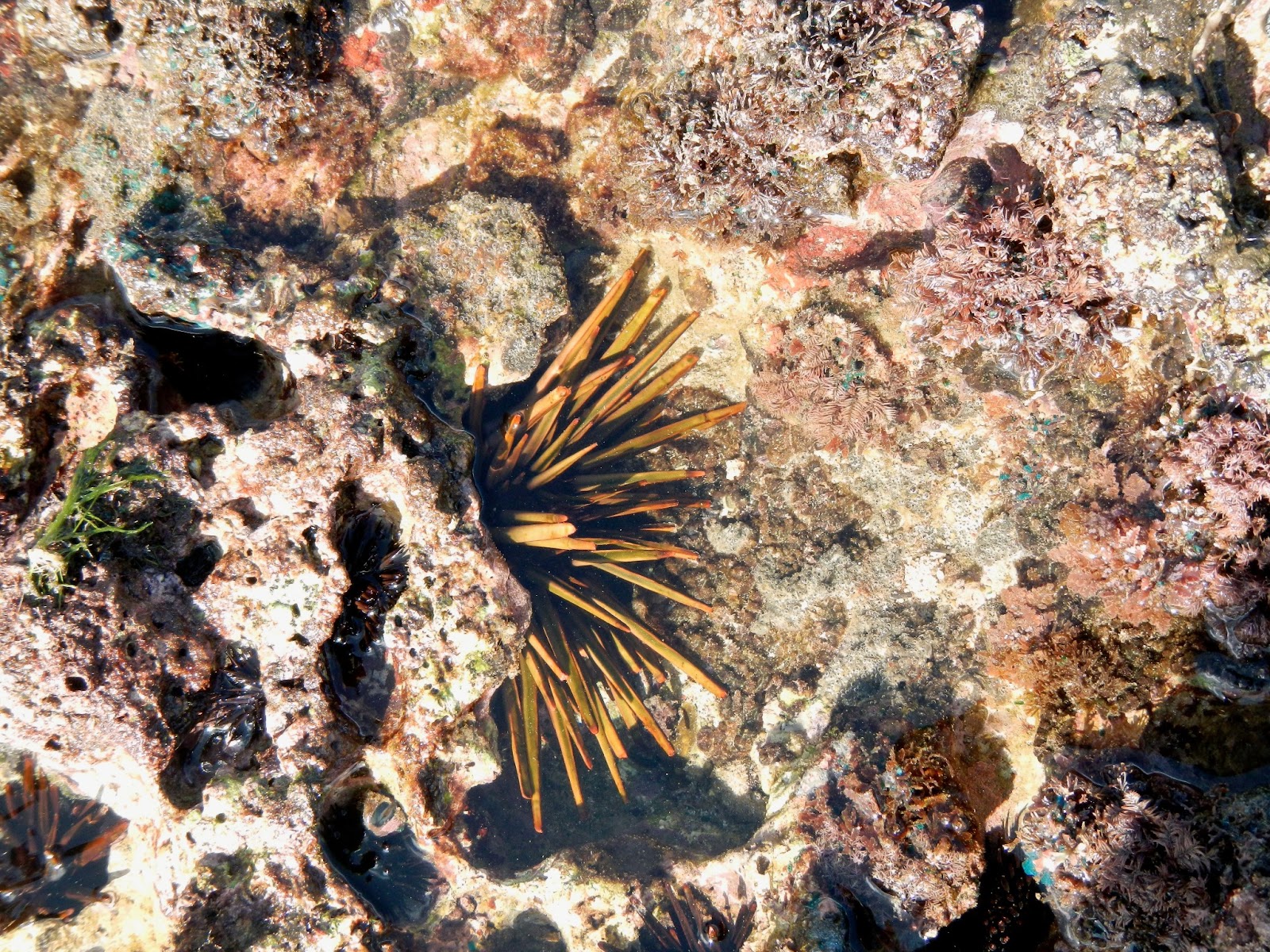
A giant sea urchin 
A woman picking up hermit crabs to sell 
Women swimming in their hijabs

The view out of the amazing cave we found! 
Me, Courtney and Bila in the cave
Amazing corals!
The sand is so different and entirely made up of coral
Sunset